

With July 1 fast approaching, the 16th Latvian Song and Dance Festival in the United States will soon begin in Grand Rapids, Michigan. For the festival organizers, these final weeks leading up to the event are both exciting and, of course, somewhat stressful as well. To provide a glimpse of the preparations, we offer a conversation with festival board members Anda Vizule, Daina Līzenberga, and Diāna Pone.
With the festival just around the corner, how are you feeling?
The festival organizing committee has done an extraordinary amount of planning, and we are ready. What we envisioned is coming together successfully. Naturally, there are still many small details to attend to. As they say, the devil is in the details. Overall the preparations are proceeding smoothly, no major setbacks. We are ready and excited to bring our program to life and showcase our city.
The festival relies entirely on volunteers. We are extremely grateful to everyone who has stepped forward to help in any capacity. More than 200 volunteer positions have already been filled, but we still need a few more helping hands. If you have the time and energy, we warmly encourage you to volunteer.
How would you describe the festival’s geographic reach? Where are the participants coming from?
The festival will bring together 23 choirs from three countries—the United States, Latvia, and Brazil, as well as individual singers from Canada. Of the 37 folk dance groups participating, eight are from Latvia, one is from Switzerland, and the remainder are from the United States.
It is especially exciting to see that quite a number of choirs and dance groups will be traveling from Latvia to participate. Why do you think there is such strong interest in attending our festival?
There are a variety of reasons. Many participants have relatives in America, and the festival provides a wonderful opportunity to spend time with family. For many, this will also be their first trip to the United States. It is no secret, either, that the cost of staying in our Midwestern city is lower than in many of the large cities on the East or West Coast.
Also artists from Latvia are invited to perform here, and we believe that appearing at the festival is an honor for them as well. We want to highlight their talents and celebrate their achievements.
Of course, we do not seek to compare our festival to the Song and Dance Festival in Latvia. We know that would be impossible. We are only a small part of that larger tradition, but we do everything we can to preserve our Latvian identity and cultural traditions outside Latvia.
Based on ticket sales so far, which events are generating the greatest interest?
The greatest interest has been in the Festival Choir Concert on the evening of July 4 and the culminating event, the Grand Folk Dance Concert, My Beautiful Fatherland (Skaista mana tēvu zeme). There has also been strong interest in the New Choreography Showcase and in the performance by our guests from Latvia, the dance ensemble Daiļrade.
At the same time, people are purchasing tickets for events held outside the major concert venues such as the Parade of Latvian National Costumes. And, of course, everyone enjoys a good party—tickets for the festival dances have been selling quickly, and only a limited number remain.
Overall, it is fair to say that there is interest in all of the festival events. More than half of the concerts and programs are already sold out. But tickets are still available for every concert and event.
How would you encourage non-Latvians to attend the festival? What would you do to show that they are welcome and that there will be plenty to enjoy and experience?
Folk dance, which speaks through movement, is a living reflection of our history and culture. It offers a wonderful opportunity to observe dance steps performed to music, admire beautiful folk costumes, and gain a deeper understanding of Latvian traditions.
For music lovers, language is not as important. Consider how many people attend opera performances in Italian, which they do not necessarily understand. They go because they love the music. We hope that our festival will also be an interesting and engaging experience for non-Latvians, as it offers a unique cultural opportunity.
It is also worth noting that quite a number of Latvian Americans and their spouses of non-Latvian background are taking part in the diaspora Song and Dance Festival, both as performers and as audience members, for the first time. These are not only children, but also middle-aged individuals who were either born in or have long lived in the United States. This, of course, makes us very happy.
How is the collaboration with the city of Grand Rapids progressing, knowing that so much Latvian will be heard throughout the city during the first week of July?
Collaboration with the city has been truly excellent. We are working hand in hand with the Grand Rapids marketing organization Experience Grand Rapids (Experience GR). This organization’s representative, Savannah Christiansen, even joined us last year at the Latvian Song and Dance Festival in Toronto to gain a deeper understanding and feel for our Song and Dance tradition. She has helped us spread information about the festival and ensure that everything needed is in place. We have received so much support and practical assistance in planning the festival parade and the open-air dance celebration (Zaļumballe), which will take place in the city center.
Together with the Grand Rapids brewery Founders and Latvia’s Valmiermuiža, we created a special festival beer, Svētku pils. In a small team of five to six people, we visited local restaurants throughout the city, telling them about the festival and encouraging them to open their doors to visitors during the festival days. We believe there will be no shortage of guests. With the help of Experience GR, we are coordinating transportation services, spreading the message that between three and four thousand people will be staying in the city for five days during the first weekend of July.
Additional safety measures have been put in place. At hotels, large concerts, and events, venue security staff will be responsible for safety. We have hired additional security to ensure that the festival parade and the open-air dance celebration run smoothly. It is also important to remember that the festival week coincides with the 250th anniversary of the United States. Several events and a fireworks display will take place in the city marking this occasion.
The United States is a nation of immigrants. We, too, are descendants of immigrants who are celebrating our culture here in the U.S. We are grateful to this country for having once offered refuge to our parents and grandparents, and for allowing us to continue to enjoy democracy and freedom here.
It is clear that ticket revenue alone cannot cover all festival expenses. How has donor support been so far?
Very strong. We have received generous donor support without which we could not organize the festival. We would especially like to acknowledge the support of the Latvian Ministry of Culture, and that of the Honorary Consuls of Latvia in the United States, who have been key contributors. We are grateful to the Latvian Song and Dance Festival Fund for entrusting us with the opportunity to host the festival in Grand Rapids and for providing financial support. A full list of donors can be found on the festival’s website.
What are some of your favorite memories from past Song and Dance Festivals?
Anda: I grew up in San Francisco, where I danced and participated in the festival with my folk dance group. It is a great sense of fulfillment and pride to be part of such a large-scale event. My folk costume was given to me by my godmother, and I will be wearing it again at the Grand Rapids festival.



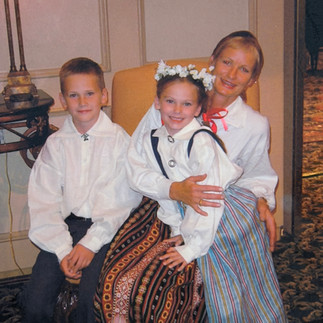
Daina: I have participated in festivals in the United States and Canada, and several times in Latvia, too. The preparation and anticipation of the festival are truly unforgettable—the sense of unity and pride in doing something in the name of Latvian identity. I have sung in the legendary Kalamazoo choir “Dziesmu vairogs” and also danced folk dances in Kalamazoo. It is fun to realize that many romantic encounters take place during the festival—many people have even found their life partners there.


Diāna: Like most of us, I also danced folk dance. I remember that at one Toronto festival, twelve of us shared a single hotel room. That probably wasn’t easy for the hotel staff… Now, when nearly nine hundred dancers will be participating at the Grand Rapids festival, I can’t forget the feeling of being part of something so large—especially at the beginning and the end of the festival. I wish everyone the chance to experience it.
See you at the festival in just a few weeks!